
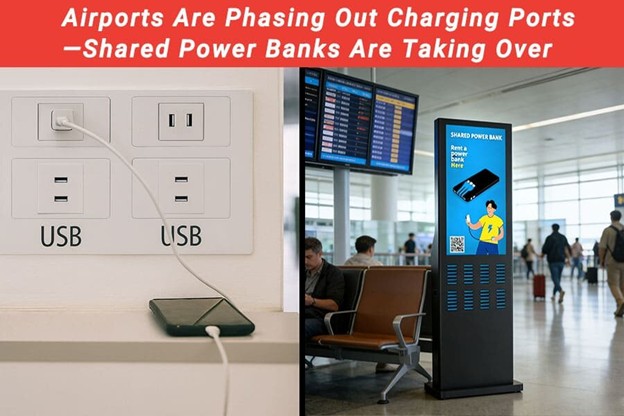
Airports Are Phasing Out Charging Ports—Shared Power Banks Are Taking Over
In the departure hall of Tokyo Narita Airport, a Chinese traveler anxiously searched through his backpack—his phone was down to just 5% battery, and the boarding announcement said only 40 minutes remained. Looking around, he noticed the traditional charging outlets were covered with “Out of Service” labels and replaced by rows of “PowerBank Station” smart rental units. Scan, rent, charge—within 30 seconds, his battery was safely restored.
This scene is happening across airports worldwide: from Singapore Changi to Dubai International, from London Heathrow to New York JFK. Traditional charging ports are retreating, while shared power banks—with both “security and convenience”—are reshaping the way travelers charge their devices.
The Decline of Traditional Charging Ports
Five years ago, most international airports were actively responding to passengers’ charging needs by installing free USB ports and outlets. These facilities were considered a standard feature of modern airports and a key part of airline service.
However, with increasing digital demand, public power supply can no longer keep up. Even with more power outlets in stations and airports, demand massively exceeds supply. Meanwhile, rapid fast-charging technology has made many fixed USB ports nearly useless.
Traditional USB charging also faces major limitations—compatibility issues, device damage, and most importantly, critical security risks. According FBI, public charging ports carry three major threats:
Data theft risk – Hackers can modify USB ports to install malicious software. In 2019, an IBN Security experiment showed a phone could be fully controlled within 30 seconds after being plugged into a malicious USB.
Physical safety concerns – Tests by Lufthansa Technik showed that electromagnetic interference from 300 fast charging modules could affect navigation systems.
Maintenance cost explosion – Delta Airlines reports USB failure rates of 23% in economy cabins, requiring up to 4-hour aircraft grounding and costing three times more than an ordinary seat repair.
These risks are accelerating the removal of traditional charging ports. Meanwhile, travelers are noticing visible changes—fixed USB outlets are disappearing, replaced by shared charging power bank rental stations.
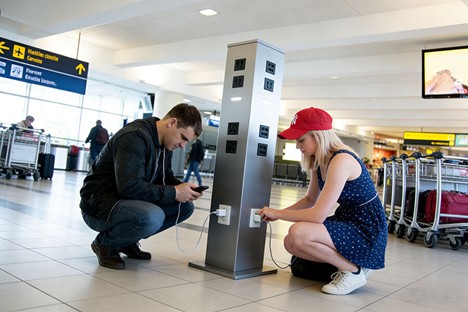
The Rise of Shared Power Banks
In departure areas, arrival halls, lounges, and even boarding gates, shared power bank stations are popping up everywhere. You can already find them in more than 200 airports worldwide.
Why are shared power banks rising so quickly?
Solving power anxiety: With smartphones now functioning as boarding passes, payment tools, entertainment centers, and communication devices, running out of battery means being cut off from everything. Surveys show over 70% of passengers fear phone battery loss during travel.
Convenient charging experience: Unlike fixed outlets, a power bank lets you move freely while charging.
Fast-charging compatibility: Most shared power banks support major fast-charging protocols, unlike outdated USB ports.
Safety assurance: Shared power banks comply with certified battery standards, making them more trustworthy for travelers.
Flexible business model: Operators provide devices and maintenance, while airports receive revenue-sharing—ensuring quality service rather than a public burden.
Shared power bank providers such as STW, which focuses on international deployment, are making airport adoption faster by offering multilingual interfaces, compliance-certified battery modules, and global rental standards
Shared Power Bank vs Traditional Charging Ports
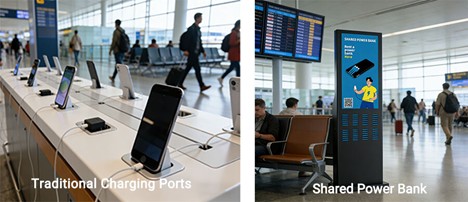
1.Usage & Convenience
Airport charging outlets
- Fixed locations
- Require user’s own cable
- Must match local plug standards
- Often fully occupied
- Must stay nearby while charging
Shared power banks
- Rent anywhere, return anywhere
- Built-in multiple charging connectors(Type-C、Lightning、Micro USB)
- Take it with you
- Return across different locations
- Supports international travelers
2.Use Scenarios
Airport outlets
- Suitable for long waiting times
- Zero cost
- Good for charging multiple devices
Shared power banks
- Emergency charging
- Mobile usage while walking, dining, waiting
- Supports cross-language and international payments
3.Safety & Device Management
Airport outlets
- Built to strict standards
- Lower privacy concerns
Shared power banks
- Built-in battery protections
- May involve data registration (but improving)
- Professionally maintained
Altough each option suits different needs, the advantages of shared power banks increasingly cover all scenarios once dominated by fixed outlets. As airports remove charging ports, shared power banks are becoming the inevitable replacement.
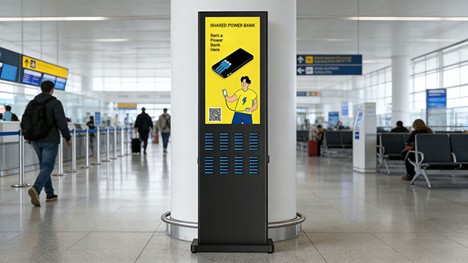
Conclusion
With shared power bank companies expanding internationally, more passengers can enjoy a consistent charging experience across major airports worldwide. Standardized procedures and universal payment systems reduce adaptation costs and eliminate the need for travel adapters. Travelers no longer have to research plug types or carry multiple converters—one rental works globally.
From the decline of fixed charging ports to the rise of shared power banks, this transition represents not only a technological upgrade, but also a shift in consumer habits and commercial logic. With greater convenience, performance, and ecosystem potential, shared power banks are becoming the mainstream choice. As global expansion accelerates, technology improves, and emerging markets grow, shared power banks are set to dominate an even larger stage.